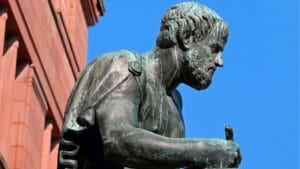
Alexander Makedonski, better known as Alexander the Great, was the third king of Macedonia and one of the greatest military leaders in history. His military gene and inexhaustible ambition allowed him to create an empire in his short life that stretched from Greece and Egypt to the borders of India. This is precisely why many consider him the most famous personality of ancient Greece and the symbol of an invincible military leader.
Alexander the Great - Early years and education
Alexander was born 356 BC in Pella, the then capital Macedonia. His father was Philip II of Macedon, a great military leader and statesman who united the Greek polis under Macedonian domination, while his mother Olympics, the daughter of the king of Epirus, was known for her piety and strong character.
Even as a boy, Alexander showed exceptional courage and intelligence. At only 10 years old, he managed to tame the wild horse Bucephalus, which would become his faithful companion in almost all battles.
At the age of 13, he got a teacher - Aristotle, one of the greatest philosophers of the ancient world. From him he learned biology, logic, philosophy, art, but also politics and rhetoric. Aristotle especially inspired him with Homer's The Iliad, so Alexander saw Achilles as his role model from then on.
Alexander the Great - Coming to the throne
After the murder of his father Philip II 336 BC., Alexander became king at only 20 years old. He immediately had to face the revolts of Greek cities and enemy tribes. He quickly suppressed the rebellions in To Thebes, Athens and Thessaly, consolidating power over all of Greece. He was proclaimed leader in Corinth Hellenistic Leagues, taking over his father's plan - a campaign against the Persian Empire.
Alexander the Great - Conquests and military campaign
In the spring 334 BC. Alexander crossed into Asia Minor with an army of about 35,000 men. His campaign was a series of impressive victories:
- Battle of the Granicus (334 BC) - victory over Persian satraps, liberation of Asia Minor.
- Battle of Issus (333 BC) – the defeat of the Persian king Darius III; Alexander proclaimed himself "master of Asia".
- Egypt (332 BC) - welcomed as a liberator, declared pharaoh and founded it Alexandria, a city that would become one of the most important centers of the ancient world.
- Battle of Gaugamela (331 BC) – a decisive victory over Darius III, after which Alexander won Babylon, Susa and Persepolis.
His conquests continued to the east - to modern Afghanistan, Pakistan and India. He faced fierce resistance in India, but despite the victories his army refused to advance, exhausted by the long wars.
Alexander the Great - Politics and vision
Alexander was not only a military leader, but also a visionary. He wanted to create a single empire of East and West, uniting the peoples through intermarriage, shared customs and a new administration. He married a Persian princess Roxanne, and encouraged his generals to accept Eastern customs, which caused dissatisfaction among the Macedonians.
He founded more than 70 cities, best known under the name Alexandria, which remained centers of Greek culture, trade and science for centuries.
Don't wander randomly! Read my article „Ferry ports of Greece“ and find out which ports are best connected, what they offer and how to choose the one that best suits your plans.
🎟️ Check out the ferry offers on the platforms Direct Ferries i Omio and find the most affordable and practical option for your next island trip!
Death and legacy
Alexander the Great died in Babylon 323 BC., at the age of 33. The cause of death is still a mystery today - possible poisoning, malaria, typhus or complications from previous wounds. His death caused chaos: the empire, which spanned three continents, was soon divided among his generals (diadochi).
His wife Roxana gave birth to a son, Alexander IV, but he was assassinated before he could take power.
Significance and legacy
Although he lived a short time, Alexander changed the world forever:
- he expanded Greek culture, language and customs to the Middle East and Asia, creating the basis for the Hellenistic civilization,
- he founded cities that were centers of trade and science for centuries,
- he united East and West in a single empire, leaving a model of empire that was later followed by the Romans.
Alexander the Great remained a symbol of military ingenuity, ambition and vision, and his story still inspires military leaders, politicians and historians around the world.