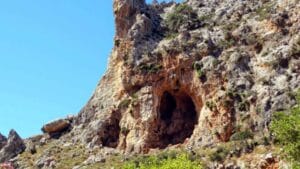
Mycenae is among the most important archaeological sites in Greece. It is located on the eastern side of the Peloponnese, near the city Nafplio, and can be easily visited for a day trip from Athens.
According to mythology, this was the city of the legendary King Agamemnon, the leader of the Greeks during the Trojan War. This place was also the scene of many myths in ancient Greek tragedies, especially the tragedies related to Agamemnon and his family. A visit to Mycenae usually does not last more than a day, as tourists mostly stay in the nearby town of Nafplion.
Ancient Mycenae is one of the most impressive archaeological sites in Greece. It is located in the Peloponnese, in mainland Greece. Dating back to the Late Bronze Age, this was the kingdom of the legendary King Agamemnon, leader of the Greeks in the Trojan War. It was an influential center of that time and gave its name to an entire civilization, the Mycenaean civilization.
Surrounded by huge walls built by the Cyclops, as the myth goes, it was a military-centric society with very limited interaction with other cultures.
The most famous spots in Mycenae, Greece are the Lion's Gate, the entrance to the city, and the Treasury of Atreus, the vaulted tomb of King Agamemnon. Archaeological Museum hosts interesting exhibits from excavations in the region. Near the site is a modern village with nice restaurants and several accommodations to stay during your vacation in Mycenae.
How to get to Mycenae?
Accommodation in Mycenae
Several hotels in Mycenae is located in a modern village, although most visitors to the region stay in Nafplio and visits ancient Mycenae every day. These hotels in Mycenae are usually family-run apartments and independent residence studies.
Mycenae sights
Known from myths and legends, Mycenae was a strong military city and gave its name to an entire era, in Mycenaean times. Discovered at the end of the 19th century, Mycenae is known for its cyclopean walls, the Treasury of Atreus and the Lion Gate.
These three are the most famous sites at the archaeological site of Mycenae. Don't miss the Archaeological Museum, which is located right next to the site and displays interesting finds from ancient Mycenae and other nearby excavations.
An archaeological site is located a short distance from Mycenae Epidaurus and beautiful city of Nafplio, which is also worth a visit.
Below you can see the best locations in Mycenae.
Lion's Gate of Mycenae
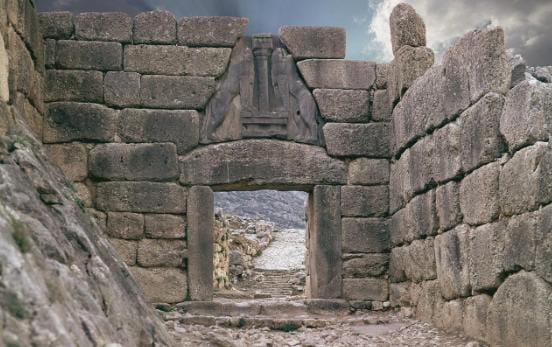
The Lion Gate marks the entrance to the fortified citadel of Mycenae. The entire gateway is about 10 feet wide and high, and the stone above the entrance gate is inscribed with two lions under a triangle. The lions on the inscription are believed to have had metal heads, but these were looted long ago. Lions are shown with their feet resting on the altar and on the side of the pillar, which was probably a symbol of power.
As you enter through the gates, inside the rock wall, inside the gate, there is a small compartment, which many believe was a guard post or was supposed to be for guard dogs. Over the years, the Lion Gate has become the trademark of the entire archaeological site of Mycenae. In the old days, there were wooden doors to close the entrance. The door opened inward and was locked with a wooden bar.
Treasury of Atreus – Mycenae
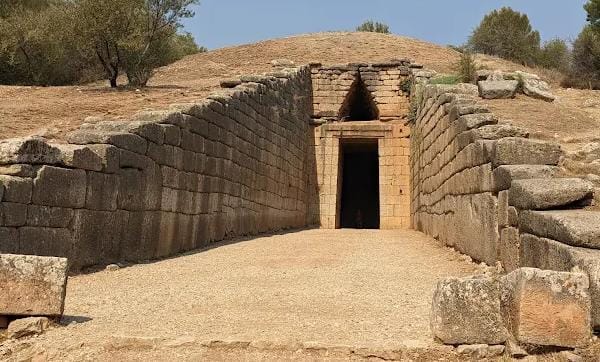
The Treasury of Atreus, also known as the tomb of Agamemnon, the legendary king of Mycenae, is within walking distance of the ancient site and is one of the most famous buildings of Mycenae. Atreus' treasury is actually a vaulted tomb built of stone, such as is usually found in the Peloponnese.

However, this tomb was partially visible when Schliemann came to Mycenae in 1879 and was looted centuries ago, leading archaeologists to believe that it contained gold and other valuables, hence the tomb's name. Not to mention that Atreus was Agamemnon's father and also the king of Mycenae.
A small path of 36 meters leads to the entrance to the tomb, which has a triangular lintel above the door, weighing about 120 tons. The interior of the tomb creates a fascinating echo, and the ceiling is vaulted. Built around 1250 BC, the Treasury of Atreus is 13.5 meters high and has a diameter of 14.5 meters. In fact, it was the tallest dome until the construction of the Pantheon in Rome. Another surprising element is that the interior of this tomb was decorated with red porphyry and green alabaster, very rare colors for that time.
Tomb of Clytemnestra - Mycenae, Greece, Peloponnese
Vaulted Clytemnestra's tomb in Mycenae dates back to about 1,200 BC. Although it is not certain whether this is the real tomb of Clytemnestra, it is believed to be so because of the gold jewelry found inside that must have belonged to the queen. In the Hellenistic era, an ancient theater was built above the tomb, which led to damage to the roof and the entrance to it. It seems that the tomb was discovered in the past because many treasures were stolen.
Clytemnestra was the queen of Mycenae during the Trojan War and the wife of King Agamemnon, the leader of the Greeks against the Trojans. Her daughter Iphigeneia was sacrificed by her father Agamemnon so that the Greek ships could sail to Troy. When Agamemnon returned from war, Clytemnestra took revenge by killing her husband.
This angered her son Orestes, who in turn killed his mother to avenge his father's death. This tragic story inspired the ancient Greek writers and was the main theme of many ancient tragedies.
Archaeological Museum - Mycenae, Greece, Peloponnese
The Archaeological Museum of Mycenae is located at the entrance to the ancient site, just a few steps before the Lion Gate. The idea to build this museum right next to the ancient site belongs to the late archaeologist Giorgos Milonas, a member of the Greek Archaeological Society. Work on its construction began in 1985, and the museum was finally opened in 2003.
The museum building is modern and covers a total of 2,000 m2. It is built in three levels and includes finds from excavations throughout the ancient site of Mycenae. A large part of the building is used for storage and elaboration of finds, and only three rooms on two levels are for exhibition.
The exhibits come from Mycenae and the wider region and represent time periods from the Copper Age around 3,000 BC to Hellenistic times in the 2nd century BC. There are about 2,500 exhibits, mostly ceramic vases, jewelry, wall paintings, tools, and weapons. Particularly impressive are the pieces of jewelry, made of gold and complicated designs.
In one of the rooms you can also see a copy of the Golden Mask of Agamemnon, a burial mask that was found in Atreus' treasury. The original mask, a funeral mask made of pure gold, is kept in the National Archaeological Museum in Athens. It has not been proven exactly, but the archaeologist Schliemann, who was the first to excavate Mycenae, believed that it was the burial mask of King Agamemnon.
The first room of the Archaeological Museum of Mycenae is dedicated to the life of the Mycenaeans with ceramic exhibits from the ancient city. Another room is dedicated to life after death and includes exhibits from the tombs, such as offerings to the dead. The third room is devoted to the Mycenaean civilization in the concepts of religion, science, art, administration and trade. At the entrance to the museum there are wall columns that tell about the history of Mycenae and its excavations. Right across the street from the entrance is a model of the ancient site.
Cyclopean walls of Mycenae
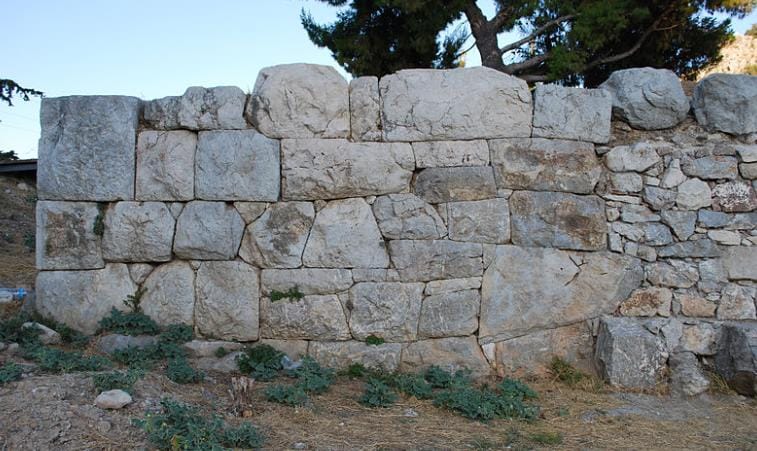
A characteristic feature of the Mycenaean walls is that they are made of huge limestone boulders, which are rather roughly fitted together. As these boulders are very large, the ancients believed that the Cyclops built these gates, as they considered it impossible for humans to move such large rocks. That's why these walls got the name Cyclopean walls.
It is noticeable that the hammer was rarely used in the construction of these walls and that they were therefore very roughly fitted. The cracks or gaps between the boulders were filled with smaller limestone. Dating from the 13th century BC, these cyclopean walls are a distinctive feature of Mycenaean architecture.
Archaeologists have noted that this type of architecture can also be seen in other Mycenaean cities, such as Tiryns or Argos. However, in 1898, Harry Thurston Peck divided Cyclopean architecture into four styles.
The first style consists of stones of various sizes filled with smaller stones. Another style consists of polygonal stones that fit together precisely. The third style is characterized by stones of unequal size but the same height, and the fourth is known for rectangular stones of unequal height. The walls at Mycenae correspond to the third style.
✨ If you travel often and want to always be sure that they are yours travel rights protected, be sure to read the entire text and discover which applications can make every trip easier for you!