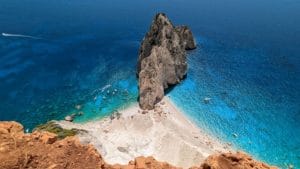
Located in the heart of the Saronic Gulf, near the island Poros i Agistri, the island of Aegina in Greece is one of the most popular islands for a quick getaway from Athens, thanks to its proximity to Athens! Many ferries from Athens depart from the port Piraeus and reach Aegina in less than an hour.
Agia Marina is the most popular seaside resort on the island, while the secluded places to visit are Souval, Vagia, Marathon and Perdiccas. The capital of the island, on the western side, is also the main port. In this picturesque small town, you will find a wide variety of cafes, restaurants, traditional taverns, shops, along its coast.
👉 Don't let the lack surprise you internet while exploring the world! Read the whole text and find out which ones are the best internet access applications for carefree and safe travels.
As for the beaches, although there are not many of them, they are temptingly beautiful! Most of them are small but organized with lots of content! The best are Souvala Beach, Agia Marina Beach and Marathon Beach. Around most of these beaches you will find a large selection of hotels, seaside taverns and beach bars. But if you prefer more secluded beaches, many of them are available along the coast of the island!

The most popular ancient monument is, of course, the Temple of Athena Aphaia, a Doric temple located in the center of the island. Other important sites, besides the Temple of Athena Aphaia, are the Temple of Apollo and the Temple of Elanius Zeus. If you are ready to discover the secrets of the island of Aegina, you can continue reading.
How to get to and around the island of Aegina?
Aegina is one of the most popular day trip destinations among Athenians, as it is relatively close to Athens. Below you will find out how you can get to this wonderful island if you are in Athens!
Accommodation, beaches and sights
✨ If you travel often and want to always be sure that they are yours travel rights protected, be sure to read the entire text and discover which applications can make every trip easier for you!
History – Aegina Island
According to ancient mythology, the island of Aegina was named after a nymph Aegina, daughter of the river god Asop. Zeus kidnapped her and took her to the island that was then called Enona. There she gave birth to his son. Echo, the first king of the island and the grandfather of the legendary Trojan hero Achilles. Ek renamed the island to Aegina, in honor of his mother.
The oldest traces
Archaeological finds in Colonies, near today's capital of the island, confirm that Aegina was inhabited as early as Neolithic (around 3000 BC). During the Bronze Age, the island was an important trading center, connected to the Clades, Crete and the Greek mainland. Its inhabitants were engaged in trade, seafaring and agriculture, and in honor of the gods they built temples. The remains of the temple have been preserved to this day Apollo in Colonna and the temple Elania of Zeus in the interior of the island.

Golden Age – Aegina Island
The real rise of Aegina began in 6th and 7th centuries BC., when the island became one of the strongest naval powers of Greece. His trade extended to Egypt and Phoenicia, and Aegina was also the first place in Greece, and even in Europe, to mint its own coins. These were the famous silver coins with the motif turtles, which was the symbol of the island.
At that time, the island was extremely rich and experienced a real boom. His fleet played a key role in Battle of Salamis (480 BC), when the Greeks won a decisive victory over the Persians. After that, the island continues to flourish - then it was raised and magnificent Temple of Aphaia, one of the most beautiful ancient sanctuaries in Greece.
Conflict with Athens
However, the wealth and power of Aegina aroused the envy of the Athenians. Years 459 BC., Athens invades the island, forces its inhabitants to tear down the city walls and surrender the fleet. With this, Aegina loses its independence and begins a period of decline.
New rulers
Like the rest of Greece, the island later came under the rule of:
- Macedonians (Philip II and Alexander the Great),
- Ptolemy in Egypt,
- Romans,
- Byzantium,
- Venetian,
- and finally Ottoman Empire, which lasted until the Revolution of 1821.
Modern history
During Greek War of Independence, Aegina played a significant role. From 1827 to 1829 the island was the temporary capital of liberated Greece. In that period, numerous important institutions were built: the first gymnasium in Greece and Eunardios School, founded by Swiss banker Jean-Gabriel Einar. He also worked on the island Yannis Kapodistrias, the first president of independent Greece, and many buildings from that period still adorn the town of Aegina today.
However, when the modern Greek state was created in 1830 with the capital in Nauplion (and later in Athens), Aegina lost its political importance. Since then, she has developed a new identity - as famous pistachio producer, by which the island is now recognized all over the world.

✨ Today, walking through Aegina, it is easy to feel the spirit of its glorious past - from ancient temples and archaeological sites to neoclassical buildings from the 19th century that bear witness to the time when the island was the heart of the newly formed Greek state.
✨ If you travel often and want to always be sure that they are yours travel rights protected, be sure to read the entire text and discover which applications can make every trip easier for you!