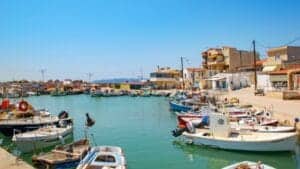
The island of Astypalea in Greece is a small island in the group Dodecanese Islands, in the southeastern Aegean Sea. Thanks to its secluded location, it managed to stay off the radar and became a great alternative destination.
Although it belongs to the group Dodecanese Islands, the island of Astypalea has a characteristic Cycladic architecture. Cubic white houses and churches, narrow streets, blue windows and wooden balconies create a unique atmosphere that will delight you, just like Cyclades! In Chora you will find many hotels, shops, restaurants and other amenities.
Chora, the capital of the island, is built on the slopes of a hill, from where there is a beautiful view of the Aegean Sea. The Querini Castle, a remnant from the Venetian era, is located on top of a hill, overlooking the countryside. This castle was used for defense during the Middle Ages and is today the main attraction of Astypalaia.
As for the beaches, those near Hora are organized, with deckchairs and umbrellas, while there are numerous taverns and hotels along the beach. Driving around the island will take you to secluded beaches, where you can relax and immerse yourself in privacy. Agios Konstantinos, Pera Ialos and Livadi are among the best seashores. Tourism has yet to take off on the island, so Astypalea is a great destination for a relaxing holiday!
How to get to and around the island of Astypalea in Greece?
AstiBus
Another affordable and environmentally friendly way to get around Astypalaia is via the island's ride-sharing service Astybus, which is based on a fleet of electric minibuses. To take advantage of this option, passengers need to download the Astymove app to their mobile phones prior to arrival, go through the registration process and enter their desired pick-up and drop-off time and location. The price of the ride depends on the number of zones included in the route, because the island is divided into 5 zones.
Accommodation, beaches and sights
History - The island of Astypalea in Greece
The history of Astypalaia is rich and varied, and its roots go back to ancient times. According to Greek mythology, Astypalea and Europa were the daughters of Phoenix and Perimedes. Due to its strategic position in the Aegean Sea and its natural resources, the island has always attracted different civilizations, conquerors and traders.
The island of Astypalea in Greece - Ancient times
Archaeological evidence shows that the first inhabitants of Astypalea were Carians in the 2nd millennium BC and then Minoans from Crete, which brought maritime trade and cultural development. During classical period (5th–4th century BC), the island became rich and prosperous, as evidenced by the high annual tribute it paid to Athens in Delian League. The Greeks called Astypalaia „"The Table of the Gods"“, because of the abundance of fruit, wine and flowers that graced the island. Numerous temples and sanctuaries were built on the island at that time, which testifies to its importance.
Hellenistic and Roman period
In Hellenistic times, Astypalaia served as an important Ptolemy naval base from Egypt and played a key role in the defense against pirates. Its natural harbors and high cliffs made it a safe haven for fleets. Under Roman rule (1st century BC - 4th century AD), the island continued to have strategic importance. The Romans developed ports and fortifications, turning the island into a commercial and military center.
Byzantine and medieval period
During the Byzantine era (4th–13th century), Astypalaia was a frequent target of pirates, which caused the inhabitants to abandon the coastal settlements and retreat to the interior of the island. From that period also originates St. John's Castle, whose remains still exist today. After the Fourth Crusade (1204), the island was briefly controlled by the Venetians, and from 1310 it came under the rule of a Venetian noble family Querini. They ruled the island for almost 300 years, built Venetian castle in Hora and fortifications to protect against pirates and the Ottomans.
Ottoman rule and modern history
In 1537, the Ottoman admiral Hajredin Barbarossa he captured the island. Nevertheless, Astypalea enjoyed a certain autonomy and reduced taxes, which allowed the inhabitants to preserve traditions and the local economy. In time Greek War of Independence (1821), Astypalaia participated in the uprising, but remained under the Ottomans until 1912, when the island was occupied by the Italians during the Italian-Turkish War. The Italians ruled the island until the Second World War, when in 1943 it was occupied by the Germans. After the end of the war and the liberation, Astypalaia together with the rest of the Dodecanese was annexed to Greece in 1948.
Modern times
Today, Astypalea is known as peaceful and traditional island, which cherishes its rich history and architecture. It stands out as one of the of the most ecologically advanced islands in Greece, thanks to sustainable initiatives and projects that encourage the use of renewable energy and nature conservation. Thanks to this combination of past and modern values, Astypalaia has become an attractive destination for travelers looking for an authentic experience, but also an example of how tourism can go hand in hand with nature protection.