Suleiman I the Magnificent (in Turkish) Suleiman the Magnificent, meaning "Lawgiver") was the tenth sultan of the Ottoman Empire and ruled from 1520 to 1566. His reign is considered the golden age of the Ottoman Empire, both in terms of territorial expansion and cultural, artistic and legislative development.
Childhood and youth
Suleiman was born November 6, 1494 in Trabzon (on the coast) Black Sea). He was the son of Sultan Selim I (known as Selim the Conqueror) and his wife Hafsa Sultana.
From a young age, he was extremely educated - he studied Arabic, Persian and Turkish language, as well as history, literature, law and military strategy. Even then, he stood out for his intelligence, justice and ambition.
As a young prince (prince), served as governor in several provinces, among others in Manisi, where he gained experience in management. He was known for his calm character, wisdom and willingness to listen to advisers.
✈️ Need help booking your next flight? Check out my guide to flight booking for the best platforms and tips to find unbeatable deals and hassle-free travel experiences!
Coming to power
After the death of his father, Selim I, Suleiman became sultan in 1520 at the age of 26. His accession to the throne was greeted with hope, as he was expected to bring peace and justice after the turbulent reign of his father.
Conquests and military victories
Suleiman was also great military leader i skilled strategist. During his reign, Ottoman Empire it reached the largest territorial extent in history. His most famous military campaigns include:
- Conquest of Belgrade (1521) - opening the way for the Ottomans to Central Europe.
- Conquest Rhodes (1522) – an important island that until then was under the control of the Knights Hospitaller.
- Battle of Mohács (1526) - in which he defeated the Hungarian army and paved the way for the conquest of a large part of Hungary.
- Siege of Vienna (1529) - although he failed to capture the city, he showed the power of the empire and caused fear in Europe.
In the east he fought against Persian (Safavid) Empire, which strengthened the borders and secured the trade routes. The Persian Empire we are talking about at the time of Suleiman the Magnificent was Safavid Empire (1501–1736) — a powerful Islamic state that was the main opponent of the Ottoman Empire in the east.
At that time, Safavid Persia was great power and it included vast territories that today form parts of several modern states.
Countries that belonged to the Persian (Safavid) Empire
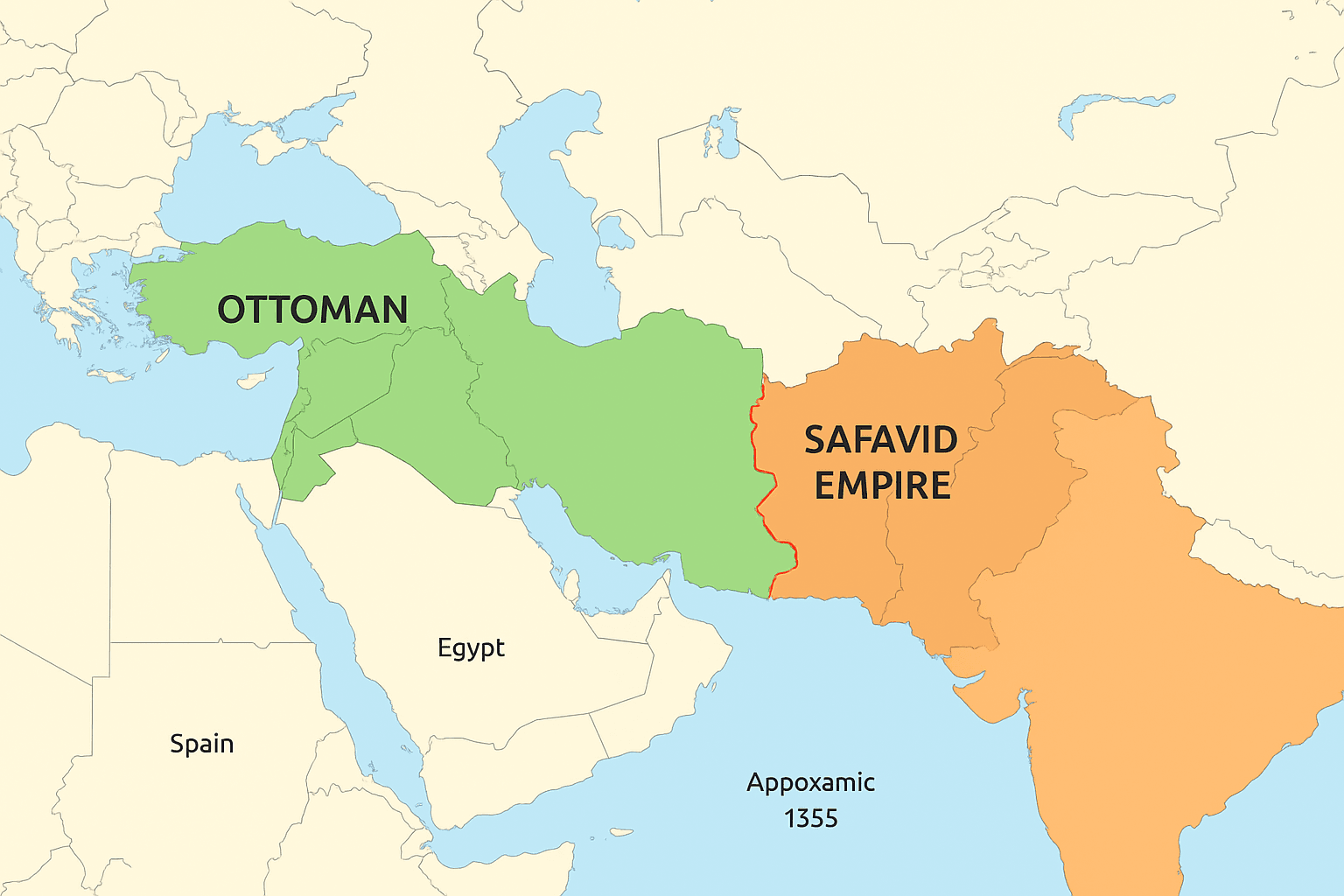
- Iran – the main part of the empire and its center; in Suleiman's time, the capital was Tabriz, and from 1555. Qazvin. Isfahan became that only in 1598, under Abbas I.
- Iraqi part of Mesopotamia – especially eastern and central parts of Iraq, including Baghdad (which occasionally passed from the hands of the Ottomans to the hands of the Safavids).
- Azerbaijan - at that time a part of Persia, important because of its strategic position and trade.
- Armenia – it was divided between the Ottoman and Persian empires, but most of it was occasionally under Persia.
- Georgia - the eastern parts of today's Georgia were under the influence of Persia.
- Afghanistan - the west with Herat was firmly in Safavid hands, while Kandahar was disputed with the Mughals and changed hands several times.
- Pakistan - over the western parts, above all Balochistan, Safavid rule was largely nominal.
- Turkmenistan - the southern parts of this country were part of the Persian region of Khorasan.
👉 Although it is crucial to have insurance, it is equally important to know how to find medical help when you need it. Check out my guide on that how to find a doctor while traveling for tips on how to be prepared for health emergencies while traveling.
Conflicts
The border between the Ottoman and Safavid empires was constant conflict scene.
Suleiman the Magnificent led several wars against the Safavids in order to consolidate control over eastern Anatolia, Iraq and Kurdistan.
The most important result of those wars was Peace of Amasya (1555), by which the Ottomans and Persians officially divided spheres of influence:
- The Ottomans retained Baghdad, Eastern Anatolia and Kurdistan,
- while the Safavids retained Iran, Azerbaijan and parts of the Caucasus.
The Persian Empire was powerful and rich empire, known for its art, architecture, philosophy and trade, but also for its constant rivalry with the Ottoman Empire for supremacy over the Middle East.
Internal policy and legislation
Suleiman was not only a warrior - he was also great reformer. Because of his legislative work, he got the nickname „"Laws" - The Lawgiver.
He introduced legal reforms which unified religious laws (Sharia) and state laws, thus creating a fairer system of governance. He especially took care of rights of subjects, taxes, trade and judiciary.
Under his rule Istanbul has become the cultural and artistic center of the world at that time. At that time they flourished. architecture, literature, music and crafts. Its main architect was Architect Sinan, who built many famous buildings - among them i Suleymaniye Mosque in Istanbul.
🏨 Looking for the perfect accommodation? My guide to finding the perfect accommodation will help you find the best options for any budget or location!
What did the reforms include?
- Unification of religious and state laws
Until then, there were two legal systems in the empire:- Sharia – Islamic religious law,
- Canon – state, secular law.
Suleiman is united and harmonized these two systems, so that the courts could justly judge Muslims and Christians and Jews.
- Tax system reform
He abolished many unjust taxes and introduced organized payment system, which prevented the abuses of local administrators and eased the position of ordinary people and peasants. - Regulating ownership of land
He determined rules on inheritance and land ownership, which protected the peasants from land grabbing by local beys and military feudal lords (landlord). - Judicial reform
He introduced uniform legal regulations throughout the country, so that everywhere was judged according to the same rules.
Judges (kadis) had to be educated and impartial. - Trade and Crafts Act
He prescribed rules for fair trade, weight and quality of goods, as well as penalties for fraud.
This protected and citizens and merchants and encouraged economic development.
Why the reforms were significant
- For the government:
- They consolidated the Sultan's power and authority.
- They provided stability in a vast empire that spanned three continents.
- They prevented the arbitrariness of local administrators and corruption.
- For citizens:
- They brought more justice and security.
- They protected the poor and the peasants from abuse.
- They made it possible orderly and peaceful society, where the law was respected.
Suleiman's legal reforms did Ottoman Empire stable, fair and strong.
That is why he was remembered not only as a conqueror, but also as wise legislator who knew that the power of the empire lies not only in the army, but also in righteousness.
Laws of Suleiman, known as „"The Canons of Suleiman the Magnificent"“, they were applied for centuries after his death.
They were created during his reign (1520–1566), but they remained the basis of the legal system of the Ottoman Empire until 19th century, i.e. more than 300 years!

His regulations were so well written and balanced that later sultans rarely changed the basic legal principles and they served as foundation of modern Turkish laws in the 19th and 20th centuries.
Modern Turkish laws were introduced at the time Mustafa Kemal Ataturk, founder and first president Republic of Turkey 1923, when is Ottoman Empire abolished, and Republic of Turkey proclaimed based in Ankara.
Ataturk implemented major reforms in all areas of life — politics, education, society and law — with the aim of making Turkey a modern, secular and European-oriented state.
Family and personal life
Suleiman got married. Hurrem Sultana (also known as Roksalana), who was a former slave of Ukrainian origin. Their love story is one of the most famous in the history of the Ottoman Empire. Hurrem had a great influence on the Sultan, and together they had several children, including a prince Selim II, who will inherit the throne.
His reign, however, was marked by tragic family conflicts – especially between his sons. On the order of Suleiman, due to political intrigues, in 1553, the shehzade was executed Mustafa – his eldest son, but from a relationship with Mahidevran, not Hur. It was the struggle over the heir that was the root of that conflict, and the execution deeply affected the sultan.
Suleiman's death at Sighet (1566)
Suleiman the Magnificent died September 6, 1566 during Siege of Sighetu (today's Szigetvár in Hungary). He had then 71 years old, which was extremely high for that era, especially for a ruler who personally led many military campaigns.
At the time of his death, the empire was at the peak of its power, and the sultan himself, despite his illness, wanted to personally lead the army, wanting to end his life "on the battlefield", like a true warrior.
He died in tent in the military camp, just before the end of the siege, but the news of his death not immediately published. His close associates, especially Grand Vizier Mehmed Pasha Sokolović, they decided to do it hide from the army in order not to panic or lose morale.
His body is embalmed, and the military campaign continued as if the sultan were alive—and Sighet soon fell.
Burying the heart and entrails in Sighet
According to historical sources, after his death, Suleiman's body could not be immediately transported to Istanbul due to the extreme heat and distance.
To preserve the body until transport, his heart and internal organs are taken out and buried near where he died — in Sziget.
The place where the heart was buried is marked small mausoleum (türbe), which later became holy place for the Ottomans. In the vicinity of that place was also built a small settlement called Turbek (today part of the city of Szigetvár in Hungary).
Why was this done?
There are two main reasons, one practical, and others symbolic:
- Practical reason:
In the 16th century, there was no way to preserve the body during the long journey from Hungary to Istanbul. Due to the warm weather and the risk of decomposition, the organs were removed and the body embalmed, so that it could be transported safely. - Symbolic reason:
According to tradition, Suleiman's heart remained where he died as a soldier — on the border of the empire he spent his whole life building.
This expresses the idea that his body rests in Istanbul, but his heart belongs to the battlefield, the place of his last triumph and sacrifice.
In the Ottoman tradition it was considered by an act of deep respect and loyalty to the empire.
Wide selection of houses, apartments and villas for vacation that provide unforgettable experiences and amenities, including more space and added privacy, for less money than a traditional hotel accommodation.
The fate of his grave
His embalmed body later transferred to Istanbul, where he was buried next to Suleymaniye Mosque, a magnificent building that he ordered himself. This is how the symbolic message was created:
„"Body in the capital — heart on the frontier of the empire."“
The tomb (türbe) in Sighet was holy place of pilgrimage for Muslim soldiers until the fall of the Ottoman Empire in that part of Europe.
Over the centuries, it has been demolished and rebuilt several times archaeological excavations between 2013 and 2016 confirmed that the remains of that mausoleum and foundations of the masjid (small mosque) raised in the place where it probably was buried sultan's heart.
Where to see Suleiman's legacy today
Everything you've read about can still be visited today, at two ends of the former empire - in Istanbul, where his body was buried, and in Hungary, where his heart remains.
Suleimanija Mosque and Sultan's Turbe
The mosque was completed by Mimar Sinan in 1557, on one of Istanbul's hills above the Golden Horn, and is considered by many to be his most mature work. In the garden behind the mosque there are two mausoleums: Suleiman's and, right next to it, the Turba Hurrem Sultana. Entrance to the mosque is free, as well as to the turbeta, but the usual dress code is respected - shoulders and knees are covered, and women cover their hair with a scarf, which can be obtained at the entrance. Arriving outside prayer time saves waiting.
The mosque is part of the historic peninsula that is under the protection of UNESCO, and from the terrace around it one of the most beautiful views of the Bosphorus. You will find more about the city itself in the text of Fr Istanbul.

Topkapi Palace
Suleiman ruled from Topkapi, and lived there with Hura - she was the first sultan to permanently move into the palace, instead of a separate court. Today, the palace is a museum, and the biggest crowd is in front of the harem and the treasury, so tickets are bought in advance. More details in the text of Fr Topkapi Palace.
Turbek near Sigetvar in Hungary
The place where Suleiman's heart was buried was long considered lost. Hungarian and Turkish archaeologists located it on the Zsibot hill near Sigetvar, in a former vineyard, and today it is a marked site with the remains of a turbet and a mosque. In Sigetvar itself, there is a memorial park dedicated jointly to Sulejman and Nikola Šubić Zrinski, the defenders of the fortress.
Sigetvar is about 200 km southwest of Budapest and is easy to get around by car, making it an interesting stop on the way to the Adriatic or back.
For the broader context of the state he ruled, see the text of Fr Ottoman Empire, and for the regions he conquered the Black Sea coast of Turkey.
Conclusion
Suleiman the Magnificent was remembered as the most powerful and longest-reigning Ottoman sultan, who spent 46 years on the throne. Under his rule, the empire reached the peak of power and cultural splendor.
His personality combines warrior, poet, legislator and man of deep emotions, which makes him one of the most complex and interesting figures in world history.