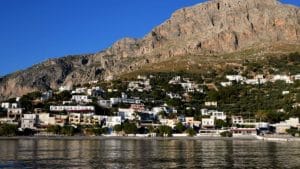
The island of Skyros in Greece is the least touristic island in the Sporades group in Greece, which is why it is perfect for those who want to escape from crowds and find their corner of peace. Here you will find secluded beaches, charming traditional architecture and a network of hiking trails that reveal the island's unique natural beauty. In addition, Skyros is a great base for exploring the surrounding islands – Skopelos, Alonissos i Evija – which are easily reached by ferry.
Chora – the heart of Skyros
The capital of the island, Chora, is one of the most beautiful villages in Greece. On the hill above the village there is an imposing Byzantine castle and the monastery of St. George - sights that should not be missed. Chora is also the perfect place for leisurely strolls through the narrow streets, drinking coffee or cocktails in the evening and enjoying the true island atmosphere. Most of the hotels and accommodation on Skyros are right here, so Chora is an ideal starting point for exploring the island.
Active vacation on Skyros
If you love nature and adventure, Skyros offers more than beaches. The island is well marked network hiking trails that go from the coast to the hilly areas, so it is ideal for hiking and exploring untouched nature.
How to get to and move around the island of Skyros?
Accommodation, beaches and sights
Sights of the Skyros hoard in Greece
Skyros is a very green and relaxing island. It is not as touristically developed as other Greek islands and this provides a special atmosphere of calmness. This picturesque island is ideally preserved for nature lovers and is actually home to a very rare breed of horse, the Skirian horse. The most interesting site on Skyros is the medieval castle on the hill above the town of Skyros and the monastery of St. George, which is located just below the castle. Walking around the town of Skyros (Chora) is a nice and good activity day and night.
Byzantine Castle - Skyros Island in Greece

Skyros Castle, built on the highest point of Skyros town and overlooking the whole area, has a long history behind it. Although not as well preserved as others in Greece, this stone fortress was built in the Byzantine era to protect the island from enemies and pirates who often ravaged the Aegean islands at that time. The architecture of the castle is simple but strong. Across the main entrance you will see a marble lion built into the wall. Although there are only a few remains of the old fortifications, Skyros Castle offers a beautiful view of the entire town and the sea.
Inside the castle is a large church, the famous monastery of Agios Georgios (Saint George), which is a dependency of the monastery of Megisti Lavra, Mount Athos. St George's Church, which was probably founded in the 10th century, has significant hagiographies and can be seen from the rocky mountains below the walls. Skyros Castle is within walking distance from the center of Skyros town.
Agios Georgios Monastery Tower - Skyros Island in Greece

The monastery tower of Agios Georgios (Saint George) is located in the castle above Hora, the capital of Skyros. This monastery was probably built in the middle of the 13th century and initially belonged to the Orthodox Patriarchate of Constantinople. Since the Middle Ages, the monastery has belonged to the Svetogorje monastery Megisti Lavra.
The buildings have been well preserved since they were built during the Venetian and Ottoman conquests of the island. The main church of St. George was built between 1599 and 1602, as indicated by the marble inscription on the bell tower. The interior of the church has valuable frescoes and a wooden carved iconostasis.
In 2001, the monastery was severely damaged by an earthquake and was completely renovated. Recently, the monastery was reopened for visits and remains open during the day. From the balcony on the west side, visitors get a magnificent view of Hora and the island.
Pony horse from Skyros

The mountains southeast of the town of Skyros are home to a unique breed of ponies that have existed on the island since the Athenians brought them in the 8th century BC. This rare breed can only be found on Skyros and today there are only a few hundred of them. Since ancient times, ponies have lived here, evolved and developed their unique characteristics isolated from the rest of the Greek islands and mainland.
Ponies are relatively short, with an average of 105 cm and a small body due to the low availability of food in the mountains. They come in beautiful Bay (reddish brown hair with a black mane and tail) and also rarely in Gray (white fur on black skin) or Palomino (golden brown hair with a white mane and tail). Skyros ponies have small heads, wide rimmed eyes, long flowing manes and thin flat shoulders.
The Scyros pony, known for its endurance, is said to have been used by Alexander the Great's army during his conquests and travels in Asia. Friezes of the Parthenon temple in Athens show such ponies. Peasants used ponies for threshing and plowing. This built a long-standing bond between the ponies and the islanders.
However, the mechanization of agriculture had a bad effect on their number. Crossbreeding with donkeys prevailed, and farmers' goats and sheep took over the mountain's food and water resources, leading to a decline in purebred ponies. Nevertheless, the locals appreciate and love them. You can see the ponies at the Skirian Pony Center on the way to Atsitsa Bay.

History of Skyros
The history of Skyros, named after the porous stones that are quarried from this island, begins in Neolithic times. According to Greek mythology, Achilles was hidden on this island by his mother Thetis, because she knew that Achilles would end tragically if he participated in the Trojan War. Thetis sought help from Lycomedes, king of the islands, who kept Achilles in his castle. Achilles soon fell in love with the beautiful daughter of Lycomedes, Deidamea, and bore him a son, Pyrrhus. Odysseus, who knew that the campaign against Troy would never succeed without Achilles, he came up with a cunning plan and succeeded in bringing Achilles to Troy. As predicted, Achilles met his end in Troy, and now Pyrrhus was needed to win Troy. Odysseus was again able to bring that very young man to Troy and make him fight bravely.
Another great hero, Theseus, is believed to have died on this island, killed by the island's king Lycomedes, who saw him as a threat to his throne. Although, under the occupation of Cimon, the remains of Theseus were returned to Athens. The island of Skyros has seen many rulers and civilizations during its tenure so far. The Pelasgians, who built huge walls as part of their cities, originally inhabited Skyros. Their walls formed the foundations for the following settlers. Around 475 BC, Cimon took over Scyros and divided the land among the Athenian aristocrats.
Athenian government
Skyros was under the control of Athens for almost 400 years. While it was under Athenian rule, Skyros was briefly under Macedonian occupation around 340 BC. After that, in 192 BC, Roman imperial forces followed and managed to take control of the island. During this period, Philip V of Macedon returned the island of Skyros to Athens. After the Roman occupation of the island, it was taken over by the Byzantine Empire. Although the island struggled under Byzantine rule, it eventually recovered and by the 2nd century AD had become a bishopric, encompassing the Christian region.
Skyros changed hands again in 1204 when the Crusaders conquered Constantinople and the island was handed over to the Venetians, who built a strong fortress to protect Skyros from enemies and pirates. In the late 14th century, Skyros was ruled by the Turks, although the lack of any high authority made life much more independent during that time. Finally, during the War of Independence in 1821 against the Turks, Skyros proved its importance with a significant contribution in terms of manpower and finances and was able to declare its independence to the world in 1829.
🏨 Looking for the perfect accommodation? My guide to finding the perfect accommodation will help you find the best options for any budget or location!